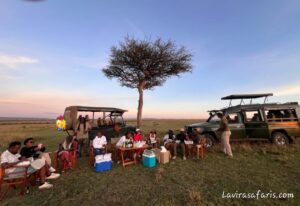
A bush breakfast on safari is not just food outside. It is the reason you got up at 5 a.m. Meals in the wild change how you remember Africa. Anyone can eat eggs in a lodge. Only a few places let you eat them while elephants drink 100 meters away and your guide listens for lion. Bush breakfasts, sundowners, and dinners in the wild matter because they break the routine of lodge life and put you inside the landscape. That is why camps in private conservancies across Kenya, Tanzania, Uganda, and Rwanda build entire days around them. They are not extras. They are the point.
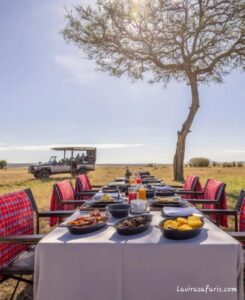
A bush breakfast happens because the rules allow it. National parks in East Africa do not allow off-road driving, walking, or fires outside designated sites. You eat in the lodge, drive for 4 hours, and come back. Private conservancies do allow it. The camp leases the land from local families, controls vehicle numbers, and sets its own rules. After your morning game drive, the guide gets a radio call. He turns off the track and drives to a flat by a river or a kopje with a view. The setup team left camp an hour before you. Tables, chairs, a canvas screen for wind, a chef, and a hot grill are already there. You arrive to bacon sizzling, coffee in a pot, and fruit cut fresh. You eat while giraffe move on the ridge. You hear nothing but wind and pans. That silence is what you paid for. A bush breakfast is only possible where space and access exist, and that is why it matters.
Meals in the wild change behavior. Animals react to vehicles, but they ignore people at a table. Lion and cheetah have walked past bush dinners because no one stood up or started an engine. You see animals act natural because you are still, quiet, and not in a car. Guides use meals to teach. At a bush breakfast your guide pours tracks in plaster for kids. At a sundowner he shows you how to read a horizon for storms. At a bush dinner the askari tells you how his grandfather hunted with a spear and how he now protects lions for a salary. You do not get that in a dining room. Meals in the wild turn staff into teachers and guests into students. That is why families remember the omelet by the river more than the leopard. The leopard is luck. The meal is design.
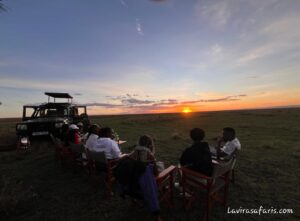
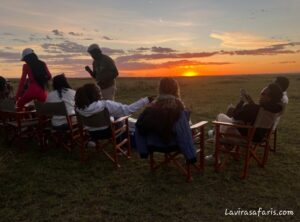
Sundowners are the other half of the story. At 6 p.m. the light goes gold and the air cools. The vehicle stops on a high point. Out comes a box. Gin, tonic, beer, juice, and biltong. You stand on grass that no one owns except the community, and you watch the sun drop behind the Oloololo Escarpment or the Serengeti plains. No fence, no other cars, no noise. A sundowner on safari is a tradition because it marks the shift from day to night. Day animals go to bed. Night animals wake up. You are there for the change. In a main park you do it in the car park at the gate. In a private conservancy you do it where the view is best and the law allows it. That is why sundowners matter. They give you a seat at the shift change in the wild.
Bush dinners are rare and that is why they stick. After a night drive you arrive at a dry riverbed. Lanterns hang in trees. A fire is lit. No electric lights. Staff serve by firelight and starlight. You hear hyena whoop and a scops owl call. You eat slow because there is nowhere to be. In a lodge, dinner ends and you go to your room. In the bush, dinner ends and you listen. Guests say bush dinners are the night they fell in love with safari. Not because of the steak. Because of the dark. Because of the space. Because you feel small and safe at the same time. That feeling does not happen under roof lights. It happens when the only light is fire and the only roof is sky. Only a few camps can do it legally and safely. That scarcity is why it matters.
These meals also change how you value the land. A bush breakfast needs a clean riverbank. A sundowner needs an open view. A bush dinner needs a safe, quiet dry lugga. If the land is fenced, farmed, or overgrazed, the meals stop. If vehicles crowd every corner, the magic dies. Camps protect these sites because they sell the experience. Your tourism fee keeps that riverbank for zebras, not maize. Your bed night pays the family that owns the kopje so they do not sell it for wheat. Every meal in the wild is a small economic vote for open space. Guests do not see that link, but it is real. The best camps pick new sites each day to spread impact. They take all trash out. They use minimal water. They leave no trace. That care is why the wild stays wild.
You cannot fake a meal in the wild. You can fake a tent. You can fake a pool. You cannot fake the quiet you get when you are the only vehicle for 10 kilometers. You cannot fake the look on a child’s face when an elephant walks past breakfast. You cannot fake the way stars look with no town within 50 kilometers. That is why bush breakfasts and meals in the wild matter. They are the moments between the animals. They are the reason you book a safari instead of a zoo. They are proof that you were not just a visitor. For an hour, you lived there.
If a safari company cannot offer bush meals, ask why. The answer tells you about land access, vehicle crowding, and rule limits. If they can offer them, ask where, how often, and who sets up. The best answers are specific. We do bush breakfast every other day on the Sand River. We do sundowners nightly unless it rains. We do bush dinners twice a week in the dry season. Specific means real. Real means you get what you paid for.
Lavira Safaris builds private safaris around bush breakfasts, sundowners, and dinners in the wild across Kenya, Tanzania, Uganda, and Rwanda.
📍 Kenya
📧 Email: info@lavirasafaris.com
📱 WhatsApp: +254721757387